Where the country starts
Gorkha is not a big place. A bazaar along a road, houses down the slope, and a long stone stair going up to a ridge where the palace sits. If you did not know what had happened here you would ride through it in ten minutes.
What happened here is Nepal. Prithvi Narayan Shah was born in this town in 1723 and inherited a hill kingdom small enough to walk across. In 1743 he started campaigning outward from it, and by 1768 he held Kathmandu, and the map that came out the other end of that is more or less the one on the wall of every classroom in the country. The word Gurkha, which the world knows from other people's armies, is just the name of this town with the spelling worn down by foreigners.
The Durbar
The palace is up the stairs, on the spine of the ridge, and it is a strange building because it is three things at once — a fort, a royal house and a temple. Red brick, dark wood, struts carved into figures, and on the day I was there a flag going in the wind. Kalika's shrine is inside it and non-Hindus are not admitted to parts of it, which is still enforced, and there are old cannons sitting outside the gate looking domestic.
You come out onto the terrace and the whole reason for building here becomes obvious. The ground drops away and you can see for a very long way in both directions, and if the air is clear Manaslu is standing there in the north at 8,163 metres — the eighth highest mountain on earth — with Himalchuli beside it. In the early morning the valleys below fill with mist so completely that the hills come out of it like islands and the palms in the foreground look like they are growing out of a sea. Then the sun works on it for an hour and it is gone and it is just a hot hillside again.
What else is here
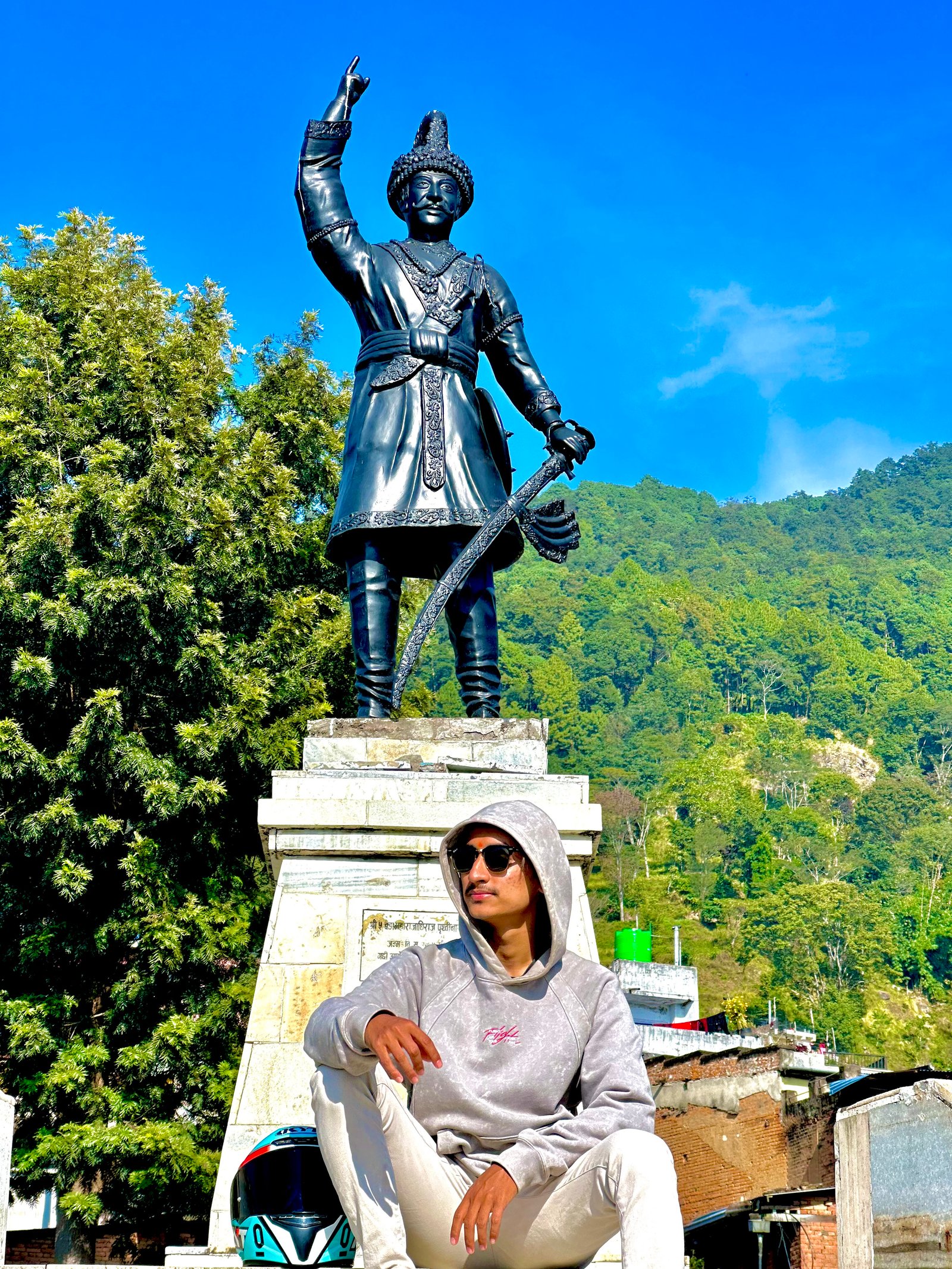
There is a statue of Prithvi Narayan Shah below the palace with his arm up and his sword down, in that pose everybody in Nepal can draw from memory, and it is smaller in real life than it is in your head. That is true of a lot of Gorkha.
The other thing about this district, which nobody who lives here needs reminding of, is that on 25 April 2015 the earthquake started underneath it. The epicentre was at Barpak, up in the north of Gorkha, and the shaking went out from there and took down a large part of the country's old buildings, this palace among them. It has been repaired. You can see where.
It is an odd feeling to stand on a ridge in a quiet hill town and be looking at both of those facts at the same time — the place a country was assembled from, and the place it was most recently broken from. Same hills. Same view of Manaslu, which did not notice either.
Next entry
Where the green gives outMustang →