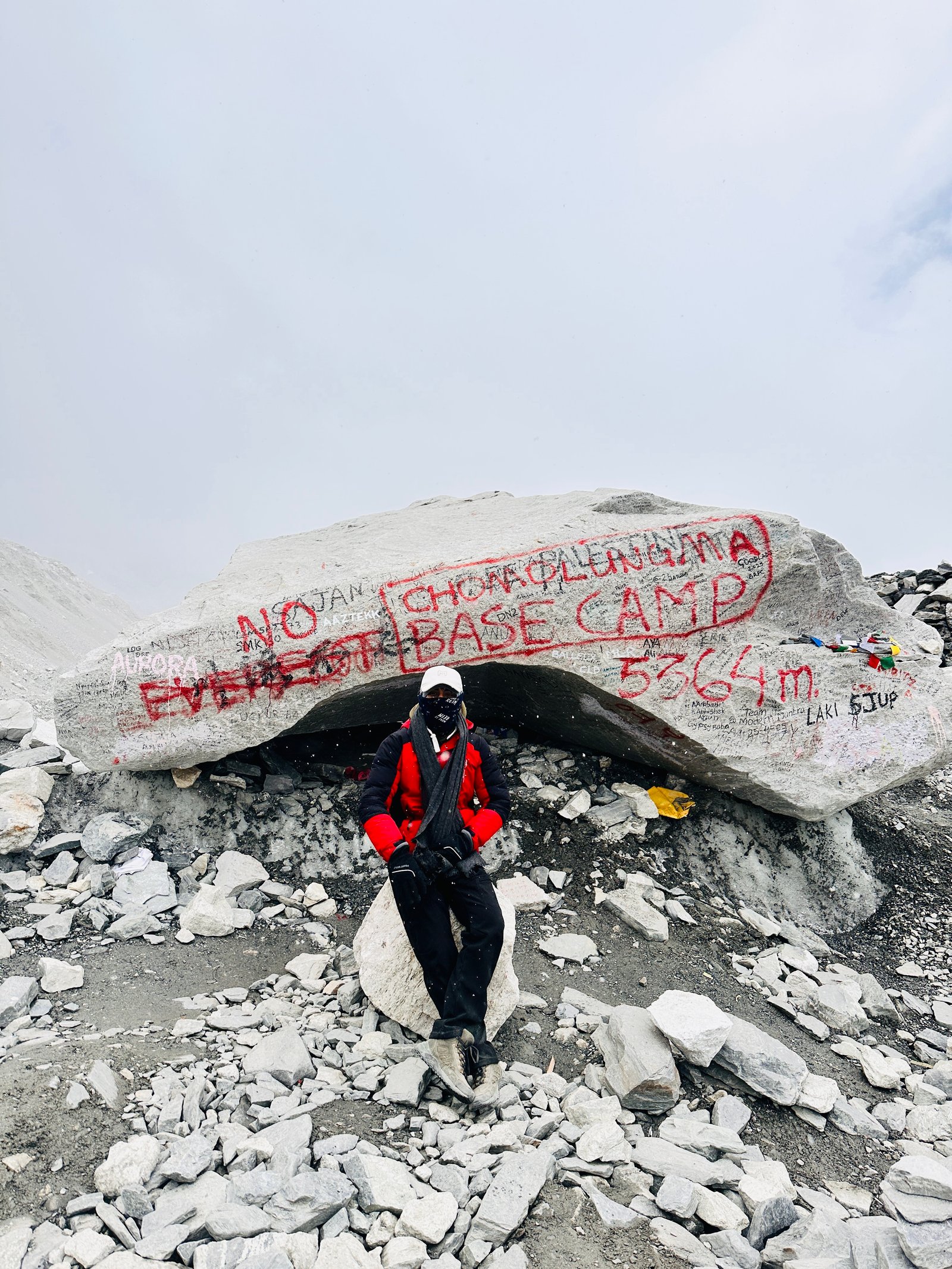
5,364
Nobody tells you this beforehand, so I will: you cannot see Everest from Everest Base Camp. Nuptse is in the way. You walk for the better part of two weeks, you gain three and a half kilometres of altitude, you arrive at the place with the name, and the mountain the name refers to is behind a different mountain. There is a rock with 5,364 m painted on it in red, and a queue of people waiting to stand beside the rock, and above them a wall of ice that is not the one they came for.
I want to be clear that this is not a complaint. It is the most honest thing the mountain does. Everest does not come out to meet you at the door.
The walk in
It starts green. At the park gate at Monjo you are still under 2,900 metres and there is moss on everything, and rhododendron, and small purple primula coming up at the edge of the path in April. The Dudh Koshi is below you the whole way, grey-white with rock flour, and you cross it again and again on suspension bridges that flex under you and are strung with so many prayer flags that in places you cannot see the far end. The river is loud enough that on the bridges you stop being able to hear anyone.
Then Namche, at about 3,440 metres, built in a horseshoe on a hillside, where everybody stops for two nights whether they feel like it or not. This is the part of the trek that is not about walking. Above about 3,000 metres the rule is that you climb high and sleep low and you go slowly enough for your blood to catch up with your ambition, and people who ignore this get carried down. The trek is mostly an exercise in being patient with your own body.
Ama Dablam appears somewhere after that and then refuses to leave. It is 6,812 metres, which by local standards is not remarkable, and it is the most beautiful mountain I have ever seen — a sharp pyramid with two arms coming forward, and a hanging glacier on its chest. The name means the mother's necklace. Everest is higher. Ama Dablam is better.
The last part
Above the treeline the colour goes out of everything. Rock, ice, the blue-grey of the sky, and then whatever you are wearing, which in my case was a red jacket that shows up in every photograph I took for a week. The villages get lower and squarer and further apart. The air is thin enough that you notice your own breathing as an activity rather than a background process.
And Base Camp itself is not really a place. It is a stretch of rubble sitting on top of the Khumbu Glacier, which is moving, roughly a metre a day in the fast parts. The ground under the tents is ice with stones on it, and it shifts, and the expeditions have to re-level their camps as the season goes on. I sat down next to a serac — one of those blue-white towers where the glacier has cracked and heaved — and it was the first time it registered properly that the thing I was sitting on was going somewhere.
The mountain is called Sagarmatha here and Chomolungma on the other side. Everest was a surveyor. He never saw it.
I came back down to the green in four days, which after two weeks of going up felt like falling. Somewhere below Namche there was moss again, and the sound of the river, and I remember being unreasonably pleased about the moss.
Next entry
Bells on a ridgeRasuwa →